How to solve the Tower of Hanoi, and why it teaches recursion
Updated · Plixoo
Short answer
To solve the Tower of Hanoi, move the top stack of all but the biggest disc onto the spare peg, move the biggest disc to the target peg, then move that stack back on top of it. Each 'move the stack' step is the same puzzle one disc smaller, solved in exactly the same way, which is why the Tower of Hanoi is the classic example of recursion. The minimum number of moves for n discs is 2^n - 1: 7 moves for 3 discs, 15 for 4, 31 for 5 and 63 for 6.
The rules
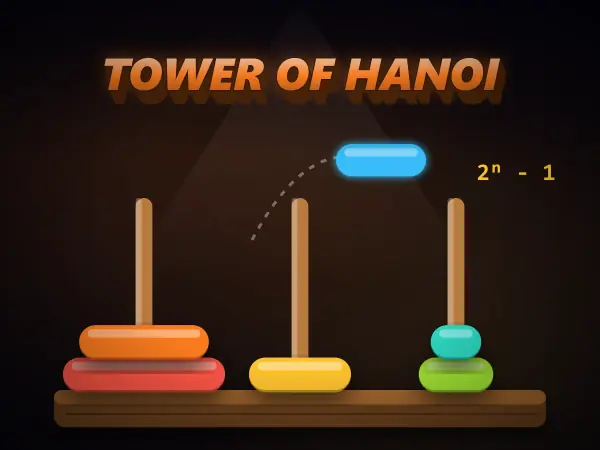
There are three pegs and a stack of discs, largest at the bottom. The goal is to move the whole stack from the left peg to the right peg. You may move only one disc at a time, only the top disc of a stack can move, and a disc may never sit on top of a smaller one.
That is the entire puzzle. The difficulty comes from the third rule: to get the biggest disc across, every other disc has to be out of the way, stacked in order, on the one peg you are not using.
The three-step solution that works for any size
Call the pegs Start, Spare and Target. To move a tower of n discs from Start to Target, do three things. First, move the top n - 1 discs from Start to Spare, using Target as the helper. Second, move the one remaining disc, the biggest, from Start to Target. Third, move the n - 1 discs from Spare onto Target, using Start as the helper.
Steps one and three are the same puzzle again, just smaller and between different pegs. You solve them with the same three steps, which call for a tower one disc smaller still, and so on down to a single disc, which you simply move. A method that solves a problem by using itself on a smaller version of the same problem is called recursion.
- Move the top n - 1 discs out of the way, onto the spare peg
- Move the biggest disc to the target peg
- Move the n - 1 discs back on top of it
Why it takes 2^n - 1 moves
Moving n discs costs two moves of n - 1 discs plus one move for the biggest disc. One disc takes 1 move, so two discs take 1 + 1 + 1 = 3, three discs take 3 + 1 + 3 = 7, four take 15, and each extra disc roughly doubles the work. The pattern is always one less than a power of two: 2^n - 1.
Nothing can beat it. The biggest disc has to move at least once, and before it can, every other disc must be stacked on the spare peg, which already costs the full solution for n - 1 discs. That is why the Tower of Hanoi counts your moves against 2^n - 1: it is a proven minimum, not a target someone picked.
The by-hand pattern
Recursion is how a computer thinks about the puzzle, but there is also a pattern you can follow without keeping track of anything. Imagine the three pegs in a circle. On every odd-numbered move, move the smallest disc one peg around the circle, always in the same direction: to the right if the number of discs is even, to the left if it is odd. On every even-numbered move, make the only legal move that does not touch the smallest disc.
Follow those two rules and the tower rebuilds itself on the target peg in the minimum number of moves, whatever its size.
The legend of the 64 golden discs
The puzzle was published in 1883 by the French mathematician Edouard Lucas, who sold it with a story: somewhere, monks are moving a tower of 64 golden discs, and when they finish, the world will end. The maths makes the story safe. 64 discs need 2^64 - 1 moves, about 18.4 quintillion, and at one move per second that would take roughly 585 billion years.
It is a vivid way to see exponential growth. Adding one disc doubles the time, so a problem that is easy at 3 discs becomes impossible at 64. The same doubling is why computer scientists care so much about how an algorithm's work grows as its input gets bigger.
Where recursion shows up in real computing
Folders inside folders are recursive: to count every file on a drive, count the files in a folder, then do the same for each folder inside it. Fast sorting methods such as merge sort split a list in half, sort each half the same way, then merge them. Fractal art, the way a web page is built from nested elements, and many game AIs that look moves ahead all work the same way.
Games mentioned here


Frequently asked questions
What is the minimum number of moves for the Tower of Hanoi?
2^n - 1, where n is the number of discs. That is 7 moves for 3 discs, 15 for 4, 31 for 5, 63 for 6 and 127 for 7. It is a proven minimum: no sequence of legal moves can do it in fewer.
What does the Tower of Hanoi teach?
Recursion: solving a problem by breaking it into a smaller copy of the same problem. It also shows exponential growth, since each extra disc doubles the number of moves, and it trains planning several steps ahead.
Who invented the Tower of Hanoi?
The French mathematician Edouard Lucas published it in 1883, together with the legend of monks moving 64 golden discs.
Is the Tower of Hanoi good for kids?
Yes. Three discs is solvable by most seven or eight year olds in a few minutes, and adding discs gives an older child a real challenge. It builds patience and planning, and it is one of the gentlest introductions to a genuine computer science idea.
More guides
The best free online games you can play with no download
Twelve browser games worth your time, sorted by what you actually want out of them.
How to play 2 player games on one phone
No second device, no accounts, no lobby. Just one screen and two people taking turns.
Are browser games safe for kids? What to actually check
The risks in kids' games are rarely the games. Here is what to actually look at.
How to get better at puzzle games
Most puzzle games have a technique. Knowing it beats being clever every time.
Why classic arcade games are still good
Five games from between 1972 and 1984 that nobody has improved on.
What to play when you are bored and cannot decide
Skip the scrolling. Answer two questions and start playing.
How does AI work? Explained for kids (and everyone else)
No metaphors about brains. What an AI actually does, why it gets things wrong, and how to show a child rather than tell them.
The best coding games for kids, and what each one actually teaches
Coding games are good at the part tutorials skip. Here is what each one teaches and where they stop being enough.
How computers actually work, from switches upward
Four layers, bottom to top. None of them are complicated, and together they are the whole machine.
How to make a strong password (and why most advice is wrong)
Length beats symbols, wordlists beat cleverness, and the advice on most sign-up forms is a decade out of date.
How to spot a phishing message: the warning signs
The seven signs that give a scam message away, and the one habit that beats almost all of them.
How to learn touch typing: a simple plan that works
Where your fingers go, what to practise first, and how long it really takes.
Morse code alphabet: the chart, the rules and how to learn it
Every letter and number, the timing rules, and the quickest way to learn it by ear.
How does sat nav find the fastest route? Pathfinding explained
The search methods behind sat nav and game AI, and why the clever one checks far fewer roads.