Morse code alphabet: the chart, the rules and how to learn it
Updated · Plixoo
Short answer
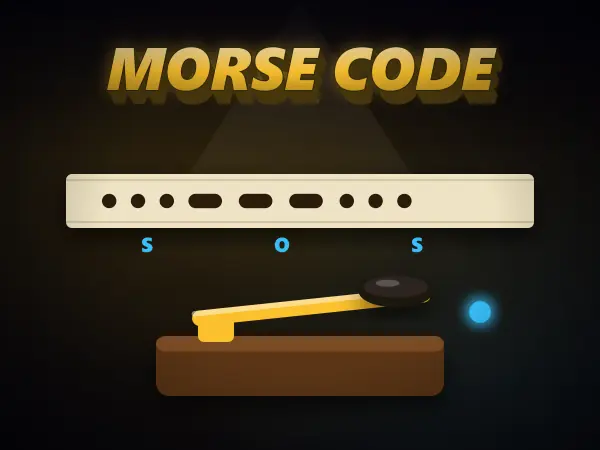
Morse code writes each letter and number as a short pattern of dots and dashes: A is .-, E is a single dot, T is a single dash, and SOS is ... --- .... A dash lasts three times as long as a dot, the gap between letters is three dots long and the gap between words is seven. The most common letters in English were given the shortest codes on purpose, the same idea modern data compression uses. The quickest way to learn it is by sound rather than by reading a chart, starting with the letters E, T, A, N, I and M.
The Morse code alphabet
This is International Morse code, the version used worldwide. A dot is often called a 'dit' and a dash a 'dah', because learning the sound is easier than learning the picture.
- A .- B -... C -.-. D -.. E . F ..-.
- G --. H .... I .. J .--- K -.- L .-..
- M -- N -. O --- P .--. Q --.- R .-.
- S ... T - U ..- V ...- W .-- X -..-
- Y -.-- Z --..
- 1 .---- 2 ..--- 3 ...-- 4 ....- 5 .....
- 6 -.... 7 --... 8 ---.. 9 ----. 0 -----
The timing rules
Morse is a code of time, not marks. A dot is one unit long and a dash is three units. Inside a letter, the gap between signals is one unit; between letters it is three units; between words it is seven. Get the gaps wrong and '..' (I) and '. .' (E E) sound identical, which is why careful spacing matters as much as the signals themselves.
Why E is a single dot
When Samuel Morse and Alfred Vail designed the code in the 1830s and 1840s, they gave the shortest patterns to the most common letters. The story usually told is that they estimated letter frequency by counting the pieces of type in a printer's cases. E, the most common letter in English, became a single dot and T a single dash, while rare letters such as Q and Z got four signals.
That makes typical messages shorter to send. Computers use exactly the same idea today: compression formats give short codes to common patterns and long codes to rare ones, which is part of how a zip file shrinks.
How to learn Morse code
Learn by ear, not by eye. If you memorise a chart, you end up translating each sound into dots and dashes and then into a letter, which is slow. Instead, listen to each letter at full speed until the sound itself means the letter, and let the gaps between letters be longer while you learn. Start with a few letters - E, T, A, N, I, M - and add two more only when you recognise those instantly.
Is Morse code still used?
Yes, in a few places. Amateur radio operators still use it because a Morse signal gets through when voice would be lost in noise. Many aviation radio beacons identify themselves with a short Morse call sign. And because it needs only one switch, Morse can be a way for people with very limited movement to type.
Games mentioned here
Frequently asked questions
What does SOS stand for in Morse code?
Nothing. SOS was chosen as the international distress signal because its pattern, ... --- ..., is easy to send and impossible to mistake. It is sent as one continuous pattern, not as three separate letters.
How long does it take to learn Morse code?
Most people can learn to recognise all 26 letters by sound in a few weeks of 10 to 15 minutes a day. Receiving at conversational speed takes longer, usually a few months of regular practice.
What is 'I love you' in Morse code?
I love you is .. / .-.. --- ...- . / -.-- --- ..- , with the slashes marking the longer gaps between words.
Is Morse code a kind of binary?
Not quite. It uses two signals, but the length of the gaps also carries meaning, so it really has more than two symbols. It is better described as an early digital code, and a clear ancestor of the ideas behind modern computing.
More guides
The best free online games you can play with no download
Twelve browser games worth your time, sorted by what you actually want out of them.
How to play 2 player games on one phone
No second device, no accounts, no lobby. Just one screen and two people taking turns.
Are browser games safe for kids? What to actually check
The risks in kids' games are rarely the games. Here is what to actually look at.
How to get better at puzzle games
Most puzzle games have a technique. Knowing it beats being clever every time.
Why classic arcade games are still good
Five games from between 1972 and 1984 that nobody has improved on.
What to play when you are bored and cannot decide
Skip the scrolling. Answer two questions and start playing.
How does AI work? Explained for kids (and everyone else)
No metaphors about brains. What an AI actually does, why it gets things wrong, and how to show a child rather than tell them.
The best coding games for kids, and what each one actually teaches
Coding games are good at the part tutorials skip. Here is what each one teaches and where they stop being enough.
How computers actually work, from switches upward
Four layers, bottom to top. None of them are complicated, and together they are the whole machine.
How to make a strong password (and why most advice is wrong)
Length beats symbols, wordlists beat cleverness, and the advice on most sign-up forms is a decade out of date.
How to solve the Tower of Hanoi, and why it teaches recursion
The three-step method that solves any size of tower, the by-hand shortcut, and the idea behind it.
How to spot a phishing message: the warning signs
The seven signs that give a scam message away, and the one habit that beats almost all of them.
How to learn touch typing: a simple plan that works
Where your fingers go, what to practise first, and how long it really takes.
How does sat nav find the fastest route? Pathfinding explained
The search methods behind sat nav and game AI, and why the clever one checks far fewer roads.