AI Games for Kids
These four free games teach how artificial intelligence actually works by making you do the machine's job. You pick the examples a bot learns from and watch it draw the wrong conclusion, you train a real spam filter and watch it count every word, you predict the next word the way a chatbot does, and you tune the weights inside a single neuron until it fires on the right things. Nothing here is a video or a quiz - each one hands you the mechanism and lets you break it.
- 4 free games
- Ages 9-16
- No download, no sign-up
What each game teaches
AI & machine learning
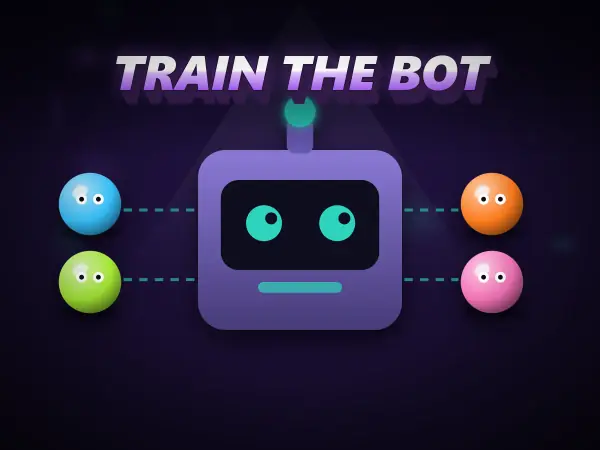
Train the Bot
You choose what examples an AI learns from, then watch the rule it invents and test it on things it has never seen. Teaches training data, prediction, and why one-sided data creates biased AI.
Play itAI & machine learning
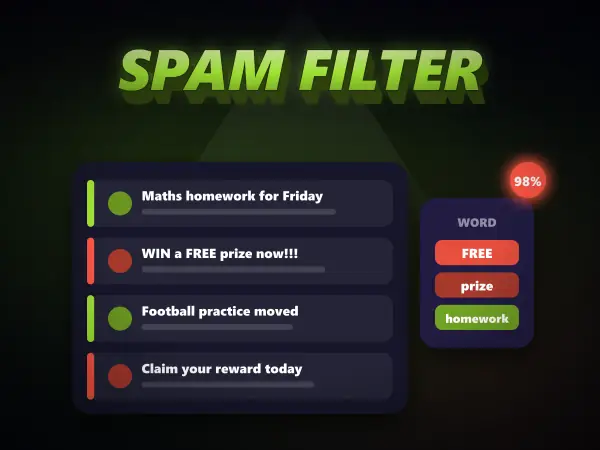
Spam Filter
Players train a genuine naive Bayes spam filter by sorting emails, watch it count words, and then see it classify new mail on its own with every decision explained. It shows first-hand that an AI learns only from its examples, that mislabelled data teaches it the wrong thing, and that unfamiliar words give it no evidence.
Play itHow chatbots work
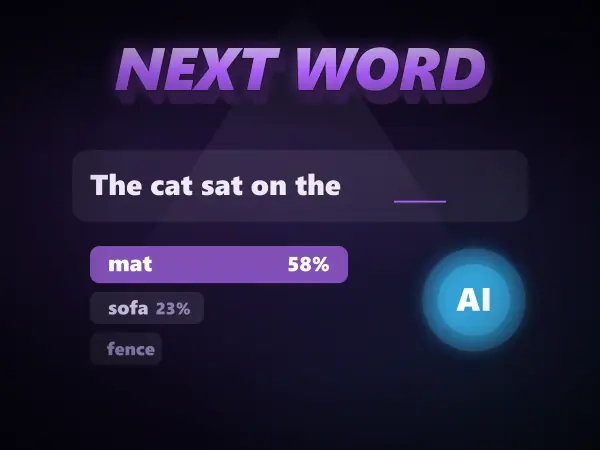
Next Word
Do a language model's actual job in a realistic chat app: read the words so far, pick what comes next, then see roughly how a model would rate every option. Teaches why ChatGPT follows language rather than truth, and what 'temperature' does.
Play itNeural networks
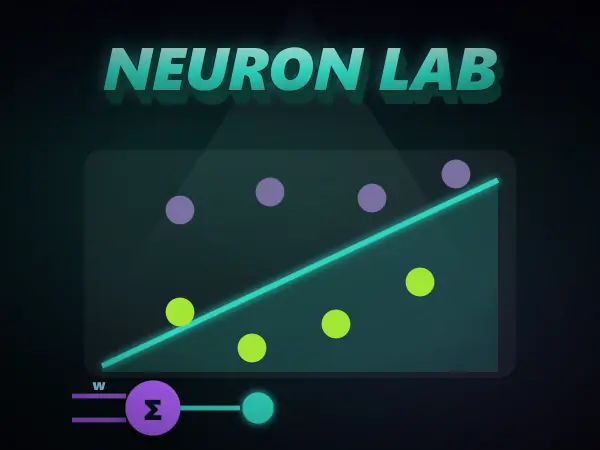
Neuron Lab
Drag the weights of a single neuron until it fires on the right things. Teaches weights, bias and decision boundaries - and ends on the famous pattern that no single neuron can ever solve.
Play itHow AI really works
Most explanations of AI for children stop at a metaphor: the computer is like a brain, it learns like you do, it gets smarter over time. Those are comforting and mostly wrong, and they leave a child unable to answer the only questions that matter in practice - why does it sometimes make things up, and why is it unfair to some people and not others?
The games here answer both by construction. In Train the Bot you personally choose the training examples, so when the bot concludes that all Blips are blue because every Blip you showed it happened to be blue, the bias is not an abstract worry. It is your fault, visibly, and you can fix it by picking better examples. That is the single most useful thing anyone can understand about machine learning.
Spam Filter shows the same idea in a real algorithm. You sort a batch of emails into Inbox and Spam, and a genuine naive Bayes filter counts how often every word turns up in each pile. Then it sorts new mail on its own and shows exactly which words swung each decision. Feed it a few wrongly labelled emails and it confidently learns the wrong lesson; show it a message made of words it has never seen and it can only shrug at fifty-fifty. That is what training data means in practice.
Next Word does the same for language models. A chatbot does not look anything up; it reads what has been written so far and works out how likely every possible next word is. Playing that role for a few minutes makes it obvious why a model states a wrong fact with total confidence - a plausible-sounding sentence scores exactly as well as a true one, because plausibility is the only thing being measured.
Neuron Lab goes one level down, to the arithmetic. One artificial neuron multiplies its inputs by weights, adds a bias, and fires if the total clears zero, which means it can only ever draw one straight line. Dragging those weights by hand is what training is, and the final level - a pattern no single neuron can solve, no matter how you set it - is the cleanest answer there is to why real networks need layers.
All four run in the browser on a phone, tablet, laptop or school Chromebook, with no download, no account and no cost. They suit roughly age nine upward, and in our experience they teach most adults something too.
Common questions
How do you explain AI to a child?
Start with the fact that an AI learns patterns from examples rather than being given rules. If you show it a thousand photos labelled cat or dog, it works out for itself what tends to be different about them - which also means it will happily learn the wrong pattern if your examples are one-sided. That single idea explains both how AI works and why it goes wrong, and it is what Train the Bot puts in a child's hands directly.
What age should children learn about AI?
Around eight or nine is a reasonable start for the core idea of learning from examples, because by then children are already using systems that recommend, filter and autocomplete for them. Understanding that those systems are predicting rather than knowing is genuinely useful before secondary school, not after it.
Why does AI make mistakes and make things up?
Because it is producing whatever is most plausible given its training, not checking anything against reality. A language model is scored on how well its text matches the patterns of real writing, and a confident wrong answer fits those patterns just as neatly as a right one. Playing Next Word makes this obvious in about two minutes.
Are these AI games free?
Yes, completely. Every game on Plixoo runs in your browser with no download, no sign-up and no payment, and that includes all four AI games. Playing them earns Pixels, the free in-site currency you spend on avatars and themes, but nothing is ever required to play.
Learning earns Pixels
Every game here counts like the rest of Plixoo. Finishing a run earns Pixels, the first completion of each game is worth a bonus, and you spend them on avatars, frames and themes.