How does AI work? Explained for kids (and everyone else)
Updated · Plixoo
Short answer
An AI works by finding patterns in examples rather than following rules someone wrote. Show it thousands of photos labelled cat or dog and it works out for itself what tends to differ between them, then applies that to a photo it has never seen. A chatbot does the same thing with text: it has learned how likely every possible next word is, so it reads what has been written so far, picks a likely next word, and repeats. That is why it can write fluently about something it has no understanding of, and why it will state a wrong fact just as confidently as a right one - it is producing what sounds plausible, not what it has checked.
The one idea underneath all of it: learning from examples
Ordinary software follows rules a person wrote. If a bank program needs to spot an overdraft, someone typed the rule: if the balance is below zero, flag it. That approach falls apart the moment the job is something nobody can write rules for, like telling a cat from a dog in a photograph. Try it - every rule you come up with has exceptions.
Machine learning does something different. Instead of rules, you supply examples that are already labelled with the right answer, and the system works out for itself what separates them. Nobody tells it to look at ear shape or nose length. It finds whatever happens to be reliably different, which is both the reason it works and the reason it sometimes learns something absurd.
This is worth being precise about with a child, because the popular explanation - the computer has a brain and learns like you do - makes everything that follows harder to understand. It does not understand anything. It has found a pattern that worked on the examples it was given.
Why AI is sometimes biased or unfair
If the examples are one-sided, the pattern will be too, and the system has no way to know. A famous real case: a recruiting tool trained on a company's past hiring decisions learned to downgrade CVs that mentioned women's activities, because the historical data it learned from reflected who had been hired before.
There is nothing mysterious in that. The system did exactly what it was asked to do - find the pattern in the examples - and the examples carried the bias. This is why the phrase to teach is not 'the AI was unfair' but 'the training data was one-sided'.
The fastest way to make this land is to let someone cause it themselves. In Train the Bot you personally choose which creatures the bot learns from. Pick five examples that all happen to share a feature and the bot will confidently decide that feature is the answer, then fail on everything new. The bias is visibly your doing, and fixing it is a matter of choosing examples that vary.
- The model finds whatever separates your examples, not what you meant
- One-sided examples produce a one-sided rule, every time
- It cannot tell you this has happened - it looks like success on the training data
- The fix is better examples, not a cleverer model
How ChatGPT and other chatbots actually work
A language model is doing one thing over and over: given the text so far, how likely is each possible next word? It picks one, adds it to the text, and asks again. Everything that looks like conversation, reasoning or personality is built out of that single repeated step.
It follows that a chatbot has no separate store of facts to check against. Nothing in it knows whether a sentence is true - it knows whether a sentence is the kind of thing that usually gets written. A plausible-sounding wrong answer scores exactly as well by that measure as a right one, which is the whole explanation for why models invent citations, dates and names with total confidence.
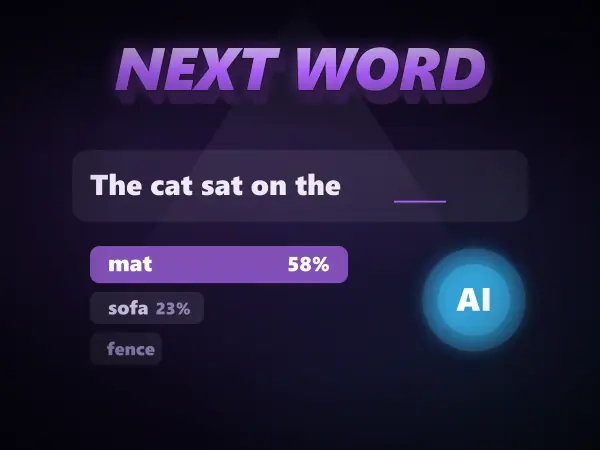
Next Word puts a person in that seat. You see a half-finished line, pick the word you think comes next, and then see roughly how a model would rate each option. Five minutes of it and the difference between predicting language and knowing things stops being an abstraction.
What a neural network actually is
Under the hood, a neural network is a large pile of extremely small pieces of arithmetic. One artificial neuron takes some numbers in, multiplies each by a weight, adds them up with a bias, and fires if the total clears zero. That is the entire neuron.
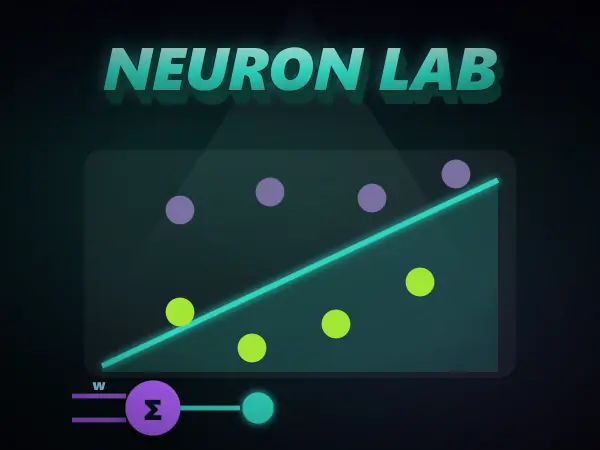
Training the network means adjusting those weights until the outputs come out right. There is no other magic step. A large model has billions of weights, but each one is doing the job you can do by hand with three sliders in Neuron Lab.
That game also demonstrates the limit that forced the field forward. One neuron can only draw one straight line, so there are patterns it can never separate no matter how the weights are set. Stacking neurons into layers is what lets the boundary bend, and that is the whole reason modern systems are called deep learning.
What to actually teach a child about AI
Three things, in this order. First, it learns from examples, so the examples decide what it learns. Second, it predicts rather than knows, so it can be fluent and wrong at the same time. Third, it is worth checking anything that matters, for the same reason you would check a very confident stranger.
That is enough to use these tools sensibly, and it is a great deal more useful than a list of rules about when not to use them. Children who understand why a chatbot invents things tend to catch it doing so.
Games mentioned here
Frequently asked questions
How do you explain AI to a 10 year old?
Tell them it learns from examples instead of from rules. If you show it a thousand labelled photos of cats and dogs, it works out for itself what is usually different about them - nobody tells it to look at the ears. Then add the consequence: if all your cat photos happened to be taken indoors, it might decide that cats are things found indoors, and get confused by a cat in a garden. That one example covers how it works and how it goes wrong.
Why does AI make things up?
Because it is producing the most plausible continuation of the text, not checking a fact. There is no separate store of truths inside a language model to compare against, so a confident invented answer fits the patterns of real writing just as well as a correct one. This is usually called hallucination, and it is a consequence of the design rather than a bug that will be patched away.
Is AI actually intelligent?
Not in the way the word usually means. Modern systems are extremely good at finding and reproducing patterns in enormous amounts of data, which covers a startling amount of what looks like thinking. They do not have understanding, intentions or awareness of being wrong, and the practical consequence is that they need checking rather than trusting.
What age should children learn about AI?
Around eight or nine for the core idea, because by then children are already using systems that recommend, autocomplete and filter for them every day. Understanding that those systems predict rather than know is genuinely useful before secondary school, and the concept does not require any maths.
More guides
The best free online games you can play with no download
Twelve browser games worth your time, sorted by what you actually want out of them.
How to play 2 player games on one phone
No second device, no accounts, no lobby. Just one screen and two people taking turns.
Are browser games safe for kids? What to actually check
The risks in kids' games are rarely the games. Here is what to actually look at.
How to get better at puzzle games
Most puzzle games have a technique. Knowing it beats being clever every time.
Why classic arcade games are still good
Five games from between 1972 and 1984 that nobody has improved on.
What to play when you are bored and cannot decide
Skip the scrolling. Answer two questions and start playing.
The best coding games for kids, and what each one actually teaches
Coding games are good at the part tutorials skip. Here is what each one teaches and where they stop being enough.
How computers actually work, from switches upward
Four layers, bottom to top. None of them are complicated, and together they are the whole machine.
How to make a strong password (and why most advice is wrong)
Length beats symbols, wordlists beat cleverness, and the advice on most sign-up forms is a decade out of date.
How to solve the Tower of Hanoi, and why it teaches recursion
The three-step method that solves any size of tower, the by-hand shortcut, and the idea behind it.
How to spot a phishing message: the warning signs
The seven signs that give a scam message away, and the one habit that beats almost all of them.
How to learn touch typing: a simple plan that works
Where your fingers go, what to practise first, and how long it really takes.
Morse code alphabet: the chart, the rules and how to learn it
Every letter and number, the timing rules, and the quickest way to learn it by ear.
How does sat nav find the fastest route? Pathfinding explained
The search methods behind sat nav and game AI, and why the clever one checks far fewer roads.