Coding Games for Kids
These free coding games teach the three things a programmer actually does: write a sequence of instructions, work out why it did not do what you meant, and test something until you understand its behaviour. You program a robot before it moves a step, hunt the single broken line in a short program, and interrogate a mystery function until you can name its rule. Tower of Hanoi then shows you the idea that trips up every programmer once: a solution that uses itself. No language to install and no syntax to memorise.
- 4 free games
- Ages 8-16
- No download, no sign-up
What each game teaches
Coding & algorithms
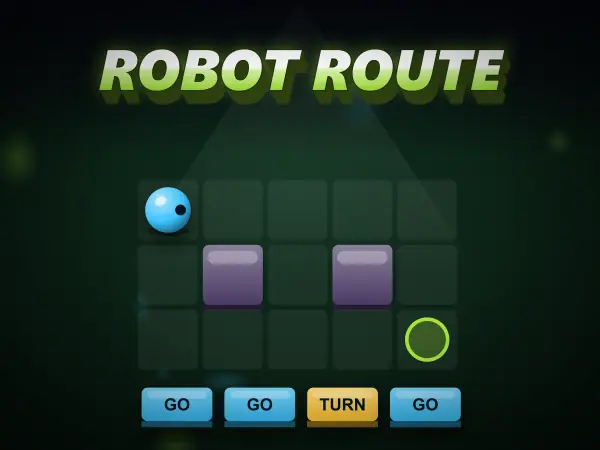
Robot Route
Write a full program before anything runs, then watch the robot do exactly what you wrote. Teaches sequencing, loops and debugging - the first three ideas in every coding course.
Play itDebugging & reading code
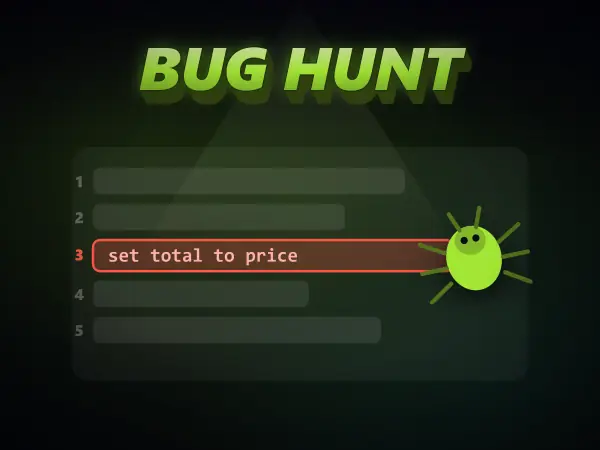
Bug Hunt
Read a short program, compare what it says to what it should do, and find the one line that breaks it. Teaches the off-by-one, the overwritten total and the loop that never ends - the bugs that catch professionals too.
Play itFunctions & testing
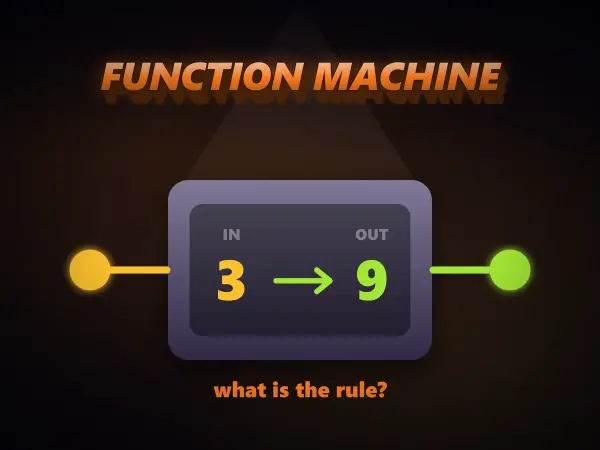
Function Machine
Drop numbers into a mystery machine and work out its rule. Teaches what a function is, and the harder lesson that one test proves nothing - you have to pick inputs that tell the candidates apart.
Play itRecursion & algorithms
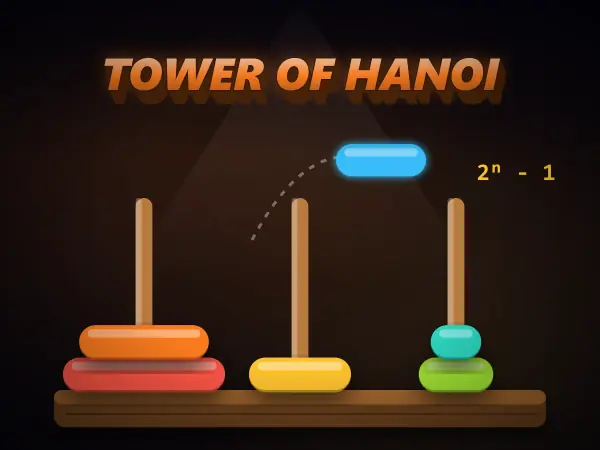
Tower of Hanoi
Players solve the classic disc puzzle and discover that the whole solution is one recipe used inside itself, which is recursion. Watch mode animates the recursive algorithm with a live call stack, and towers of up to 8 discs show why the moves grow as 2 to the power of n, minus 1.
Play itHow children actually learn to code
Learning to code is usually taught as learning a language, which is why so many people stall after the first tutorial. Syntax is the easy part and it is the part a search engine can hand you. The hard parts - thinking in precise sequences, reading code that is wrong, and testing an idea properly - are skills, and skills need reps.
Robot Route starts with the most important habit in programming: you write the whole program before anything happens. There is no nudging the robot square by square. You lay out the full sequence, press run, and watch it execute exactly what you wrote rather than what you meant. That gap between intention and instruction is where every bug in history has lived.
Bug Hunt is the other half of the job. Each puzzle gives you what a real bug report gives you - what the program should do, what it actually did, and the source - and asks you to find the line at fault. The bugs are deliberately the common ones: the loop that runs one time too few, the running total that gets overwritten instead of added to, the comparison facing the wrong way, the return that quits before the work is done. None of them are typos, because typos are not what makes debugging hard.
Function Machine teaches the testing mindset. A function is a machine: put a number in, get a number out, same answer every time. You feed it inputs until you can name its rule - and quickly discover that one test proves nothing, because putting in 3 and getting 6 out fits both doubling and adding three. Choosing an input that tells two theories apart is exactly what writing a test case is.
Tower of Hanoi is the classic puzzle for recursion. Moving a tower of five discs sounds hard until you see that it is three steps - move the four above out of the way, move the big one, move the four back - and that moving four is the same puzzle again. Its Watch mode solves the tower by itself while a live call stack shows each smaller copy of the problem waiting its turn, which is exactly how a computer runs a recursive function.
Robot Route and Function Machine need no code at all, and Bug Hunt's programs are short, real Python - a few lines each, with the goal written in plain English and every variable visible as it changes - so a child can read them on day one. Everything transfers: the reasoning is identical whichever language they eventually pick up.
Common questions
Can you really learn to code by playing games?
You can learn to think like a programmer, which is the part that takes longest. Games are very good at drilling sequencing, debugging and testing because they give instant feedback on each attempt. What they will not do on their own is teach you a specific language's syntax, so they work best as the thing that comes before, or alongside, writing real code.
What age can a child start coding?
Five or six for the idea of giving a machine a sequence of instructions, and around eight for genuine programming concepts like loops and conditions. Robot Route works from roughly seven upwards, while Bug Hunt and Function Machine suit nine and older because they involve reading and reasoning about code rather than assembling it.
Do I need to know a programming language to play?
No. Robot Route uses snap-together blocks and Function Machine needs no code at all. Bug Hunt shows short programs in real Python, but each is only a few lines like 'total = total + price', with the goal in plain English above it, so you can follow them without having learned any language first. The reasoning you practise applies to every language.
What should a child learn first in programming?
Sequencing, then loops, then conditions, then debugging - roughly in that order, though debugging starts the moment the first program goes wrong. The single most valuable habit to build early is reading your own code back and asking what it actually says, rather than what you hoped it said.
Learning earns Pixels
Every game here counts like the rest of Plixoo. Finishing a run earns Pixels, the first completion of each game is worth a bonus, and you spend them on avatars, frames and themes.