Binary Hunt
Tap MIDDLE or drag the tape to aim, then press SCAN (arrow keys and Enter work too)
What is Binary Hunt?
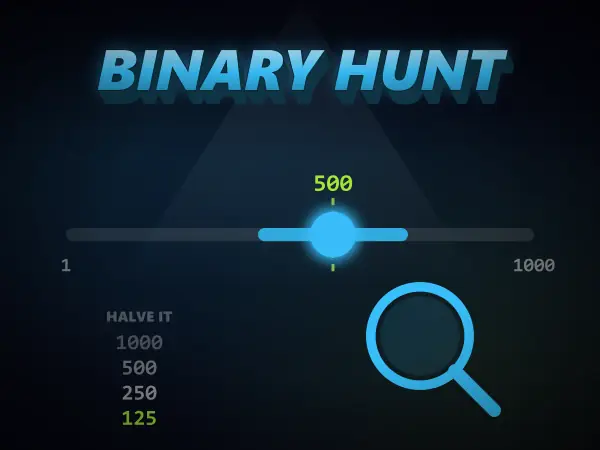
Binary Hunt is a free game about the most useful idea in computer science: halving. A treasure is hidden at one number on a scanner tape, and every scan tells you whether it is higher or lower. Scan the middle every time and a thousand possibilities collapse to one in about ten scans, because each scan throws away half of everything still in play. The half that cannot hold the treasure greys out and slides away, so you watch the search space disappear.
How to play Binary Hunt
Controls: Tap MIDDLE or drag the tape to aim, then press SCAN (arrow keys and Enter work too)
- 1A treasure is hidden at one number on the tall scanner tape. Big numbers are at the top.
- 2Aim the scanner: tap MIDDLE, drag the tape, or use the up and down buttons.
- 3Press SCAN. The console lights up HIGHER or LOWER and a big arrow points the way.
- 4The half that cannot hold the treasure goes grey and slides away, and what is left stretches to fill the tape.
- 5Keep scanning the middle until you find the treasure. Five rounds, growing from 1 to 20 up to 1 to 1000.
- 6Fewer scans is a better score. Scanning the middle never needs more than the max shown on the console.
Binary Hunt tips and strategy
- Always scan the middle. The MIDDLE key aims there for you, and taking it guarantees you remove half the remaining numbers no matter what the answer turns out to be.
- Guessing near an edge is the trap. It feels bold, but if you are wrong you have eliminated almost nothing and wasted a turn.
- Watch the STILL POSSIBLE counter. A middle scan always cuts it roughly in half; if it barely moves, that scan was wasted.
- Doubling the range only costs one more scan. If 1 to 100 takes seven, 1 to 1000 takes ten - which is worth remembering the next time something sounds impossibly large.
Binary Hunt FAQ
What is binary search?
A method for finding something in a sorted list by repeatedly checking the middle and throwing away the half that cannot contain it. Because each step halves the problem, the number of steps grows extremely slowly - doubling the data adds only one step.
Why is binary search so much faster than checking one by one?
Checking one at a time takes up to a million steps for a million items. Binary search takes twenty, because halving a million twenty times leaves you with one. That gap is the difference between a search that feels instant and one that never finishes.
How many guesses do you need for 1 to 100?
Seven, if you halve every time. One hundred halves to fifty, then twenty-five, thirteen, seven, four, two and finally one. For 1 to 1000 the answer is ten, which surprises most people the first time they see it.
Where is binary search used in real life?
Everywhere something has to be found quickly in sorted data: looking a word up in a dictionary, a database finding a row by its index, version control tracking down which change broke a build, and your phone finding a contact as you type. It is also what you do naturally when guessing a number.